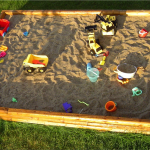
At Intel Labs, I worked on a project that positioned data from mobile sensors and web APIs as the raw material for playful experience. I aimed to empower users through simple tools for experimentation, invention, and self-expression. As part of this research, I prototyped an evocative “Data Monster” which looked something like a cross between… Read more »
December 17, 2015
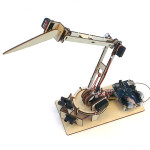
Interning at Intel Labs, I researched and designed new playful ways of engaging with data in everyday life. As part of this project I conducted fieldwork with teens, prototyped “data-sandbox” toolkits, designed and led playtests with target demographics, interviewed luminaries in the field of play, and synthesized findings with emerging opportunities in the fields of IoT and quantified-self. Outside participants included… Read more »
December 16, 2015
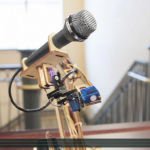
The AudienceBot Microphone is an interactive platform that enables audiences to convey feedback to performers in real-time. Using a mobile application audience participants collectively determine the “mood” of the microphone. The microphone utilizes six servo motors and a motion tracking device to express a range of affective states, from inattentive to attentive and from playful… Read more »
November 3, 2014
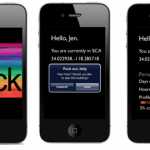
As a collaborator on Jen Stein’s dissertation project PUCK, I worked with Jeff Watson on datavisaulizations of the SCA building’s 100s of sensor feeds. [Project lead: Jen Stein; Dissertation Chair: Prof. Scott Fisher; MEML team: Jacob Boyle, Joshua McVeigh-Schultz, Hyung Oh, Amanda Tasse, Jeff Watson; Storyboard illustrations: Bryant Paul Johnson]
February 8, 2012
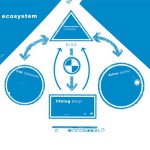
(2010) Collaboration with Michael Annetta. This design uses XML data from NAVTEQ to translate daily traffic flow at particular road sections into a rhythmic pulses that maps onto PWM voltage for vibrating motors. By the year 2060, all the humans who survived peak-oil live in giant honeycomb-like structures that contain self-sustaining mini-ecologies within each geodesic… Read more »
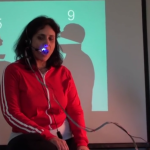
Designed as a critique of status monitoring in online contexts, this project presents a prototype of a prosthetic device that conversation partners wear in their mouths to provide visual and auditory feedback about the speaker’s level of online popularity (measured in retweets). The speaker with more current retweets experiences voice amplification (and their mouth glows… Read more »
‘Ambient storytelling’ — part of the design philosophy of USC’s Mobile and Environmental Media Lab — represents a departure from customization algorithms familiar to discussions of pervasive computing. Rather than thinking about how a car can play the role of glorified butler, anticipating its driver’s every need, instead we reposition the car as co-participant in an… Read more »
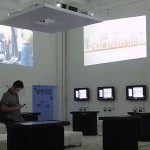
I was a collaborator on 6under60, an installation at the Shenzhen Urbanism/Architecture Bienanale in 2011. As a key member of the interactive design team, I directed recruitment and outreach to our collaborator cities, led design of the metadata architecture for both installation and web interfaces, co-designed the concept and user experience of the installation and website, built a metadata collection interface,… Read more »
February 7, 2012
The Movie Tagger project (a continuation of work described here and here) was initially inspired by a grand vision to parse and richly tag every movie ever made. With an eye toward exploring new models of folksonomic “expert-sourcing”, I set out to interview 12 film different scholars in order to adapt their research to metadata tagging schemas and… Read more »