Redesigning Rituals of Public Assembly


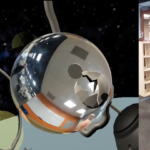
This project consists of a series of workshops designed to explore new models of live audience interaction. I am interested here in tinkering with the interactional rule-set of audience-performer-interaction. In November of 2011 I collaborated with Kevin Driscoll and A. J. Patrick Liszkiewicz on a workshop titled Occupy this Seminar.

The approach here eschews technologically sophisticated platforms, and instead places emphasis on a deliberate tweaking of the unspoken social contract that guides rituals of public assembly. This work resonates with approaches familiar within the Occupy movement, where rituals of consensus formation (like the General Assembly or human mic) point to new models of public interaction. These workshops often involve simple objects as props, but emphasis is on novel interactional rule-sets, the symbolic affordances of objects, and the emergent properties of group attention and expression. For example, the “conch shell” scenario in Lord of the Flies conveys the kind of simple ritual invention that I have in mind. I like this example because it suggests both the symbolic potency of the conch shell but also the opportunity for breakdown. It is in this interstitial space between symbols, rules, and breakdown that I’m interested in exploring.

Synaptic Crowd: Vox Pop Experiments


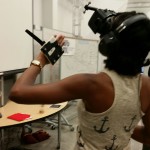
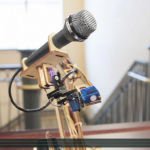
Essentially the Synaptic Crowd platform enables online participants to conduct collaborative “on the street” interviews without actually having to be “on the street.” Interviews are conducted in physical space through an intermediary wielding a camera and a phone, but the responsibility of determining questions gets placed on the shoulders of the audience participants.

The Synaptic Crowd tool integrates browser and mobile interfaces, along with face-to-face interaction. 
Online participants submit potential questions or statements to a public pool, and then the question or statement that has been selected most gets relayed to the intermediary’s phone.

Online participants watch the interviewee’s response as they formulate follow-ups. By enabling a live feedback loop between audience and subject, the Synaptic Crowd shuffles the agencies of the interview and enables participants to ask different kinds of questions than are normally licensed by a traditional interview format. These audience generated questions often create contextual breakdown by forcing participants to mix intimate and professional registers. As the interviewee (and phone wielding intermediary) try to make sense of these contextual curve-balls, a new kind of civic space gets carved out with new intersection points between the personal and the political. In this sense, I situate the work as “making trouble” for the assumptions that traditional journalism creates when it uses social media sampling and vox pop interviews to curate the public back to itself.

The Synaptic Crowd: Vox Pop Experiments, serves as a key example for me in demonstrating what it might look like to reimagine our civic rituals from the ground up.  Drawing upon McLuhan’s imagery of electronic media as prosthetic extensions, the project explores a series of performative experiments that reposition the “street” (and other public spaces) as sites to be activated by remote audiences.

For more information, here is a talk I gave at DIY Citizenship conference in which I discuss how the involvement of a live audiences disrupts our expectations about the interview form. You can take a look at the prototype here (although keep in mind that the tool only works when it’s live, and right now that means “we” have to turn it on). Going forward, we’d like to create a scalable version that anyone can use, and our Knight News Challenge proposal aims to do just that.

(2009) Work originally exhibited at the Santa Cruz Museum of Art & History in InterActivate, the MFA Thesis Show for UC Santa Cruz’s Digital Arts and New Media program. Created in collaboration with developer Brian Alexakis.

[Project lead: Joshua McVeigh-Schultz, Flash and VXML development: Brian Alexakis, Videography: Lorenzo Estébanez and Joshua McVeigh-Schultz]

Wild State Touch Interface

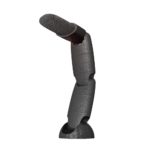
Completed for Phil van Allen’s New Ecologies of Things course at the Art Center, this project presents prospective interactants with a touch interface that doesn’t “want” to be touched.

When touch screen interface devices are found in the wild, their shielding appendages haven’t been clipped yet. As you might expect, these appendages have to be surgically removed before the devices can be domesticated and shipped for sale.

This design explores a familiar user interface paradigm (touch screen interaction) and reframes it as invasive, awkward, and potentially erotic. In this way, I treat the interactions between humans and objects as themselves rituals to be tinkered with and defamiliarized.

By frustrating the typical user expectations about touch interfaces, I recast the iPod touch as an animistic object whose skittish behavior suggests trauma. While the object follows a user with its “gaze”, it clamps shut in response when one attempts to touch it forcefully. Instead, users need to earn the object’s trust before it will allow itself to be touched or stroked—an action that triggers a change in the object’s data-visualization display.

This approach to animism drew inspiration from Phil van Allen’s critique of ubicomp’s utopian fantasies and Brenda Laurel’s writing on animism (2008).

Popularity Prosthetics: Retweet Popularity Monitor for Face-to-Face Conversation


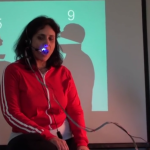
Designed as a critique of status monitoring in online contexts, this project presents a prototype of a prosthetic device that conversation partners wear in their mouths to provide visual and auditory feedback about the speaker’s level of online popularity (measured in retweets). The speaker with more current retweets experiences voice amplification (and their mouth glows a clear blue) while the less popular interlocutor gets quieter and their mouth glows red. The design aims to call attention to problematic features of the “marketplace of attention” that structures the amplification of “speech” in online contexts. In this way, I deliberately designed the objects to frustrate communication by awkwardly interjecting online status into meat-space.

Special thanks to Laila Shereen Sakr and Rosemary Comella for helping me to demo this project.

Ambient Storytelling for Vehicle-Driver Interaction


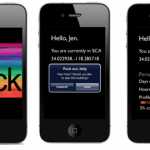
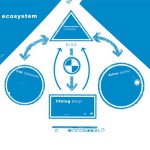
‘Ambient storytelling’ — part of the design philosophy of USC’s Mobile and Environmental Media Lab — represents a departure from customization algorithms familiar to discussions of pervasive computing. Rather than thinking about how a car can play the role of glorified butler, anticipating its driver’s every need, instead we reposition the car as co-participant in an evolving relationship. We use the framework of the Lifelog Interface as a portal though which drivers can engage with their vehicle as a new kind of experience platform. In our model, the car is no longer merely transport but a springboard for adventure, a “drivable” musical instrument, a 21st century scrapbook, and a playful reimagining of what it means to drive. Our prototype transforms the concept of a car key — which we see as a tangible avatar of the vehicle — into an evocative interface object. When drivers return home, this object beckons them and offers a portal into the Lifelog Interface. The interface itself plays on the metaphor of concentric tree rings to represent units of time. Navigating through these rings, drivers can visualize, plan, organize, and reflect on a variety of experiences including: (1) soundscape compositions generated by the car’s internal and environmental sensor data, (2) in-car augmented reality games, (3) guided-tour adventure modes, (4) networked trip planning, (5) car configuration and lifecycle milestones, (6) badges and social media portals. Finally, our system is designed to analyze not only the ways that drivers engage with space, media, and other drivers, but also the ways in which drivers choose (or refuse) to engage with the system itself. This iterative feedback loop between vehicle and driver allows the driver to build on their own projections and aspirations for their car as a resource for constructing the story of their vehicle as an evolving “character.”

[Mobile and Environmental Media Lab: Principle Investigator, Prof. Scott Fisher; Project Lead: Jen Stein; MEML Team: Emily Duff, Joshua McVeigh-Schultz, Jen Stein, Jeff Watson; Storyboard illustration: Cecilia Fletcher; Microsoft Surface Table programming: Emily Duff]

Vehicular Lifelogging: Discovering Story and Remapping Context


This project extended our work with automotive lifelogging by using in-car sensors to engage drivers in ongoing discoveries about their vehicle, driving environment, and social context throughout the lifecycle of their car. A goal of the design was to extend the contexts of automotive user-interface design by (1) looking inward to the imagined “character” of the car and (2) looking outward to the larger social context surrounding a drive. We deployed storytelling and theatrical strategies as a way of moving our thinking outside the familiar constraints of automotive design. These unique methods help us to extend the concept of a lifelog to consider the “lives” of objects and the relationship between humans and non-humans as fruitful areas of design research.

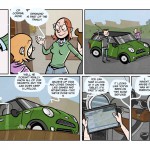
Within the mobile and environmental media lab we spend a lot of time using and thinking about strategies of narrative prototyping. The typical interaction-design prototypes are intended to be tested over minutes rather than years. By conducting narrative exercises and scenario crafting in visual media such as storyboards, animations, and video, we have access to a deeper understanding of time over longer durations of interaction. In our work with BMW’s Mini line, this storytelling strategy has helped us to probe new possibilities for vehicular lifelogging by raising questions about multiple drivers and encouraging us to consider novel subjects like location-based memory annotation as a conceivable topic of automotive design. This process allowed us to ask questions about longer chains of causality and probe the possibilities of more ambient modes of storytelling and speculate about the ways that experience unfolds over the entire lifecycle of the car.

[Mobile and Environmental Media Lab: Principle Investigator, Prof. Scott Fisher; Research Assistant and Project Manager, Joshua McVeigh-Schultz; MEML Team: Michael Annetta, Jacob Boyle, Emily Duff, Hyung Oh, Jen Stein, Avimaan Syam, Amanda Tasse, Jeff Watson, Simon Wiscombe; iOS Programming: Jacob Boyle; Storyboard illustration: Bryant Paul Johnson]

Heisenberg Eyes

lisa-eyes.gif
I’m interested in interactive systems that get completed by leaps of imagination or by social mediation. One example I’ve pointed to is the elevator close-door button. This is a device that is often non-functional yet nevertheless encourages us to assign causality even where there is none. Building on this the idea, I created a responsive system that is only triggered when a user closes their eyes.

Continue reading