Synaptic Crowd: Vox Pop Experiments


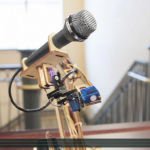
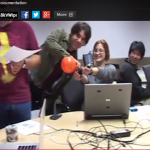
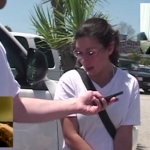
Essentially the Synaptic Crowd platform enables online participants to conduct collaborative “on the street” interviews without actually having to be “on the street.” Interviews are conducted in physical space through an intermediary wielding a camera and a phone, but the responsibility of determining questions gets placed on the shoulders of the audience participants.

The Synaptic Crowd tool integrates browser and mobile interfaces, along with face-to-face interaction. 
Online participants submit potential questions or statements to a public pool, and then the question or statement that has been selected most gets relayed to the intermediary’s phone.

Online participants watch the interviewee’s response as they formulate follow-ups. By enabling a live feedback loop between audience and subject, the Synaptic Crowd shuffles the agencies of the interview and enables participants to ask different kinds of questions than are normally licensed by a traditional interview format. These audience generated questions often create contextual breakdown by forcing participants to mix intimate and professional registers. As the interviewee (and phone wielding intermediary) try to make sense of these contextual curve-balls, a new kind of civic space gets carved out with new intersection points between the personal and the political. In this sense, I situate the work as “making trouble” for the assumptions that traditional journalism creates when it uses social media sampling and vox pop interviews to curate the public back to itself.

The Synaptic Crowd: Vox Pop Experiments, serves as a key example for me in demonstrating what it might look like to reimagine our civic rituals from the ground up.  Drawing upon McLuhan’s imagery of electronic media as prosthetic extensions, the project explores a series of performative experiments that reposition the “street” (and other public spaces) as sites to be activated by remote audiences.

For more information, here is a talk I gave at DIY Citizenship conference in which I discuss how the involvement of a live audiences disrupts our expectations about the interview form. You can take a look at the prototype here (although keep in mind that the tool only works when it’s live, and right now that means “we” have to turn it on). Going forward, we’d like to create a scalable version that anyone can use, and our Knight News Challenge proposal aims to do just that.

(2009) Work originally exhibited at the Santa Cruz Museum of Art & History in InterActivate, the MFA Thesis Show for UC Santa Cruz’s Digital Arts and New Media program. Created in collaboration with developer Brian Alexakis.

[Project lead: Joshua McVeigh-Schultz, Flash and VXML development: Brian Alexakis, Videography: Lorenzo Estébanez and Joshua McVeigh-Schultz]

Vehicular Lifelogging: Discovering Story and Remapping Context


This project extended our work with automotive lifelogging by using in-car sensors to engage drivers in ongoing discoveries about their vehicle, driving environment, and social context throughout the lifecycle of their car. A goal of the design was to extend the contexts of automotive user-interface design by (1) looking inward to the imagined “character” of the car and (2) looking outward to the larger social context surrounding a drive. We deployed storytelling and theatrical strategies as a way of moving our thinking outside the familiar constraints of automotive design. These unique methods help us to extend the concept of a lifelog to consider the “lives” of objects and the relationship between humans and non-humans as fruitful areas of design research.

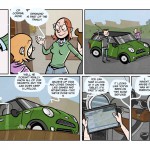
Within the mobile and environmental media lab we spend a lot of time using and thinking about strategies of narrative prototyping. The typical interaction-design prototypes are intended to be tested over minutes rather than years. By conducting narrative exercises and scenario crafting in visual media such as storyboards, animations, and video, we have access to a deeper understanding of time over longer durations of interaction. In our work with BMW’s Mini line, this storytelling strategy has helped us to probe new possibilities for vehicular lifelogging by raising questions about multiple drivers and encouraging us to consider novel subjects like location-based memory annotation as a conceivable topic of automotive design. This process allowed us to ask questions about longer chains of causality and probe the possibilities of more ambient modes of storytelling and speculate about the ways that experience unfolds over the entire lifecycle of the car.

[Mobile and Environmental Media Lab: Principle Investigator, Prof. Scott Fisher; Research Assistant and Project Manager, Joshua McVeigh-Schultz; MEML Team: Michael Annetta, Jacob Boyle, Emily Duff, Hyung Oh, Jen Stein, Avimaan Syam, Amanda Tasse, Jeff Watson, Simon Wiscombe; iOS Programming: Jacob Boyle; Storyboard illustration: Bryant Paul Johnson]

Place-based, Ubiquitous, Connected, and Kinetic Experiences for Interactive Architecture


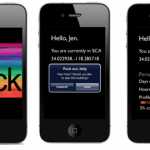
As a collaborator on Jen Stein’s dissertation project PUCK, I worked with Jeff Watson on datavisaulizations of the SCA building’s 100s of sensor feeds.

[Project lead: Jen Stein; Dissertation Chair: Prof. Scott Fisher; MEML team: Jacob Boyle, Joshua McVeigh-Schultz, Hyung Oh, Amanda Tasse, Jeff Watson; Storyboard illustrations: Bryant Paul Johnson]

Dendritix: Inter-dimensional Gnome Hunt

Dendritix Rules

This locative game was designed in collaboration with Jeff Watson, Juli Griffo, and Ed Yee. It requires partners to collaborate via mobile phones as they navigated through physical and virtual worlds. One player navigates a text-based MUD modeled after the real-life rooms of the play space while the other navigates through physical space. The text-world-navigator can spot the interdimensional gnomes when they enter a room in the MUD and must quickly communicate the location to the physical-navigator without attracting the attention of the other players.

Narrative Overview:
Interdimensional Gnomes are on the loose! Ingest dendritix pills to travel in the gnomes’ dimension. Teams compete to find and capture the elusive gnomes. Gnomes can only be captured when you utter their true name. One team member searches for gnomes in a drug facilitated virtual world while the other sneaks about in the physical world carrying out naming-missions and trying not to lose their tail. Watch out for other teams who may thwart your attempts to win the game.