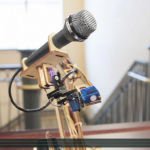
The AudienceBot Microphone is an interactive platform that enables audiences to convey feedback to performers in real-time. Using a mobile application audience participants collectively determine the “mood” of the microphone. The microphone utilizes six servo motors and a motion tracking device to express a range of affective states, from inattentive to attentive and from playful… Read more »
November 3, 2014
(2010) Collaboration with Michael Annetta. This design uses XML data from NAVTEQ to translate daily traffic flow at particular road sections into a rhythmic pulses that maps onto PWM voltage for vibrating motors. By the year 2060, all the humans who survived peak-oil live in giant honeycomb-like structures that contain self-sustaining mini-ecologies within each geodesic… Read more »
February 8, 2012
Designed as a critique of status monitoring in online contexts, this project presents a prototype of a prosthetic device that conversation partners wear in their mouths to provide visual and auditory feedback about the speaker’s level of online popularity (measured in retweets). The speaker with more current retweets experiences voice amplification (and their mouth glows… Read more »
Inspired by my own experience as a liminal subject in Japan, this project explores the tensions between my sense of self as a foreigner in Japan and the image of the westerner in Japanese media. I focused especially on the issue of translation (or translational adaptation), as the piece was originally written in English and… Read more »
February 7, 2012
Set in the context of telecom immunity debates of 2007 and 2008, Secrets for Senators is a performative intervention in which intimate secrets are confessed over the phone to senators who support warrantless wiretapping. This work considers the current threat of pervasive surveillance and illegal spying as a kind of psychic violence inflicted by the… Read more »
Elephant in the Relationship was designed in collaboration with Andy Uehara, Michael Annetta, and Casey China. Exhibited at Game Show NYC. Elephant in the Relationship is a game for 2 to 4 players in which players try to communicate deeply troubling relationship issues. Players take on the roles of two people in a personal relationship… Read more »
February 5, 2011